Rightsizing material handling systems:
Why “good enough” often delivers better ROI

Depending on who you ask, system design for distribution and fulfillment operations may be driven by a simple assumption: More automation, more speed and more technology is always the right way to go.
It is not hard to understand that mentality. The onslaught of headlines announcing the advance of humanoid robots and AI make more automation a seemingly inevitable outcome. But in the race to optimize, there’s one fundamental question that many operations tend to overlook:
What problem are we truly trying to solve?
The goal of fulfillment centers and sorting facilities is to support business objectives, not to serve as a showcase of the latest technologies. It is true that the most sophisticated conveyance or sortation solution will increase throughput, shorten startup time and reduce operating costs for certain applications. However, that is not the case for every operation — and the investment is not always justified. The best warehouse systems do not have to be the most advanced. They need to fit the operation they are meant to support.
Just as importantly, they need to match the pace at which the business itself is changing. Distribution models, labor strategies, package profiles and customer expectations are constantly evolving. A system designed to run for 20 years without modification is not an ideal investment if the operation it supports could look substantially different in five. Flexibility is just as important as performance.
Rightsizing material handling solutions comes down to four basic principles:
- Define the business problem
- Challenge capacity assumptions
- Balance capability with complexity
- Plan for future evolution
Start with business requirements, not technology
Every operation and facility has its own unique requirements. Product mix, order profiles, package sizes, available labor, seasonality and rate of growth are all factors that figure into what the “right” material handling solution looks like. Nevertheless, many organizations start with a preconceived notion of the equipment they need instead of the business outcome they are trying to achieve.
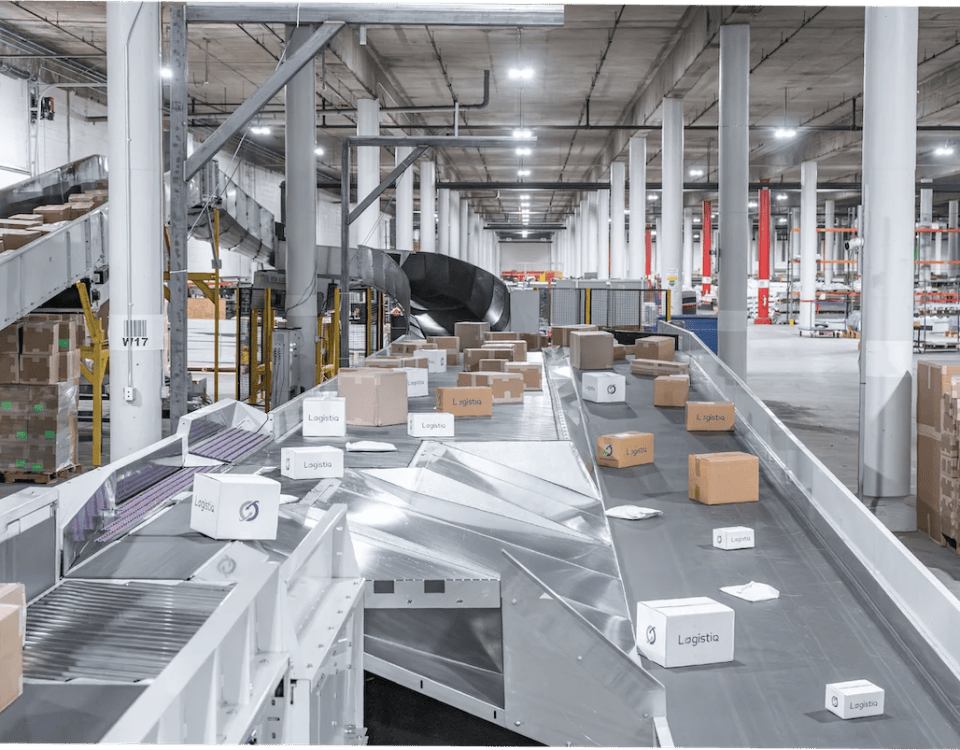
In parcel handling, for example, belt conveyors had become the de facto standard for moving packages. For years, many operators were hesitant to believe another option could be viable. That mindset has gradually changed as modular roller-based systems have been proven capable of handling many of the same applications at a lower price point, and with greater flexibility and faster installation. Once viewed as a compromise, roller conveyors have proven to be a better fit for many facilities. Being wed to one technology from project inception can put a wedge between what a company purchases and the capabilities that are genuinely needed.
Fate intervenes in the form of a tornado
- Challenge: Institutional inertia prevented a parcel carrier from embracing roller conveyor — until a tornado forced their hand.
- Solution: With their building destroyed, they were willing to try something new if it would get them operational quickly.
- Results: Roller conveyor was up and running in ~ 1 week, proved cost-effective and easier to modify than their original equipment. They’ve since deployed it to 150 facilities.
This shift illustrates a broader point: industry standards are not permanent truths. Belt conveyors were not “wrong.” They simply became one option among many as technologies matured. This lesson extends far beyond conveyor selection to material handling equipment in general. Equipment that was considered the singular solution ten years ago might not represent the best combination of cost, flexibility and performance today. Organizations that periodically challenge long-held assumptions are often the ones that uncover the greatest opportunities for improvement.
Balancing capacity with operational flexibility
One of the most common ways operations over-spec is by designing every system in their facilities around peak demand. Do businesses need enough capacity to handle their busiest periods? Absolutely. But building permanent automation for demand spikes that last only a few weeks at a time creates unnecessary expense and complexity for the rest of the year.
Automation has fixed mechanical limits. When a conveyor or sorter reaches its maximum designed throughput, there is no way to increase its capacity. Manual processes, on the other hand, can provide flexibility that automation can’t. For example, in one high-volume parcel operation, an efficient manual sortation process designed for approximately 14,000 packages per hour could consistently exceed 20,000 per hour when handling smaller parcels by temporarily adjusting staffing and workflow. By comparison, the fixed mechanical capacity of a fully automated system lacks the same flexibility to scale up and down as requirements change.
Often, a hybrid approach delivers the best value. Automation handles the steady baseline volume throughout the year, and additional manual processes can be added to absorb seasonal peaks or unexpected demand fluctuations. Instead of overpaying for automated capacity that sits idle for most of the year, operations should invest where automation delivers the greatest return on investment while preserving operational flexibility. The objective is not an all-or-nothing choice between manual or automated processes. It is understanding where and how they can function together and achieving the balance that offers the most value.
Flexibility also shortens the time between investment and value creation. Modular systems can often be installed and commissioned faster than highly customized automation, allowing operations to begin processing orders and generating revenue sooner. In many cases, those extra weeks of production early on have as much impact on ROI as squeezing a few percentage points of throughput from a larger system.

The quiet cost of over-specification
The costs of over-equipping systems are not paid in full with the initial capital investment. Sophisticated automated systems require more extensive operator training, specialized maintenance skills and more involved ongoing mechanical and technical support. When operations lack the resources to maintain complex equipment, reliability can quickly overtake system capability as the factor limiting productivity. Highly specialized equipment often requires technicians with advanced mechanical, controls or software expertise. If no one inside the company has those skills — or if ongoing service and maintenance was not accounted for during the planning stage — operations can find themselves owning a top-of-the-line system that is down much of the time waiting for repairs. In practice, uptime often depends less on what the equipment is capable of than on whether the organization can realistically maintain it.
Bottom line: selecting premium technology where it isn’t required increases both cost and operational risk. Instead of relying on one highly complex machine to perform a critical process, a modular approach can distribute that work across multiple smaller systems. Individual components can be easier to service or replace, failures affect a smaller portion of the operation and future modifications become less disruptive. In other words, simpler can lead to both lower costs and more resilience. It’s a win-win.
The risks of under-specification
By the same token, you shouldn’t buy a Jeep when you need a Humvee — or when you will need a Humvee soon. The lesson is not simply to anticipate growth in volume, it is to anticipate change. New fulfillment models, new package formats, evolving delivery methods and shifting customer expectations can all redefine what “adequate” looks like. Equipment decisions should reflect not only today’s operation, but where the business expects to compete in the future. Focusing exclusively on the “now” can leave operations struggling to keep pace.
Changing package profiles are a great example. A couple decades ago, the volume of oversized residential deliveries was a fraction of what it is today. Boxed furniture, exercise equipment and other large-format shipments have dramatically changed material handling requirements. Systems designed around yesterday’s package mix are likely to struggle in today’s market.
Just as the goal is not to get the most advanced, leading edge technologies when outfitting your warehouse, it also is not to buy the minimum possible equipment capability. A clear understanding of current and future business requirements dictates appropriate system design and can justify or refute additional capacity or features.
Honest requirements drive better system design
The most successful warehouse projects typically have one thing in common: a thorough understanding of the operation before equipment is selected. Too often, companies start evaluating technologies before fully defining their business in appropriate depth or how they expect it to evolve over time.
Design teams need much more than throughput targets. They need to understand inbound and outbound processes, product characteristics, seasonal demand patterns, staffing models, operational constraints and future objectives. This information helps engineers evaluate multiple potential approaches rather than forcing a single technology onto every application. Every material handling technology has its strengths, its weaknesses and its ideal applications. A conveyor that is designed to move packages 100 feet per minute is fundamentally different from one engineered to transport heavier loads at six times that speed, even if they share surface-level similarities. Package dimensions, weight distribution, flow characteristics, loading methods, desired conveyor speeds and even future software requirements influence what constitutes the right specification. Two systems might appear similar at a high-level while being engineered for fundamentally different operating conditions. The same differentiation applies across sortation and automation technologies.
Many organizations have not fully documented their own operational requirements, and not all details that can materially affect equipment selection are obvious. Experienced system designers know when to dig deeper, challenge assumptions and ask follow-up questions that uncover possibilities and constraints that might otherwise be overlooked. These conversations are often the difference between engineers developing best-fit solutions or simply optimizing the wrong ones.
- STEP 1: UNDERSTAND THE OPERATION
- STEP 2: DEFINE THE REQUIREMENTS
- - Throughput targets
- - Inbound/outbound processes
- - Product characteristics
- - Seasonal demand patterns
- - Staffing models
- - Operational constraints
- - Future objectives
- STEP 3: EVALUATE THE OPTIONS
- STEP 4: DESIGN THE RIGHT SYSTEM
Properly establishing solid requirements up front also reduces project risk. When requirements are vague or continue to change throughout the design process, schedules stretch and rework costs explode. Crystal clear operational requirements lead to more functional designs with predictable pricing and far more accurate project schedules and ROI projections. Not to mention fewer surprises during implementation and after the facility is up and running.
Redefining success
The bottom line is that every investment should support a business outcome. In some cases, the biggest competitive advantage isn’t adding more automation. Rather, it might be a more economical purchase, getting a new facility operational a few weeks sooner, adapting more easily as business requirements evolve, or reducing the maintenance burden on your team. Those outcomes often have just as much, if not more, impact on ROI as headline throughput numbers. The best manufacturers and integrators recognize this by evaluating projects through an ROI lens rather than simply recommending the most sophisticated equipment available. Instead of asking, “What can this technology do?” they ask, “What measurable business improvement will it create?” That distinction often leads to simpler systems, faster implementation and long-term returns.
In material handling system design, “good enough” should never mean settling or splashing out for the most advanced technology available with few questions asked. It should mean selecting the solution that delivers the greatest business value.